Past Year QuestionsAll examsLRDIDices & Cubes

Dices & Cubes — PYPs

2 solved Dices & Cubes previous year questions (PYQs) from past year papers — attempt each and check the answer.

Free SolutionsNo Login2 Questions
Q1:jipmat 2025LRDIDices & CubesEasyLR · MCQ
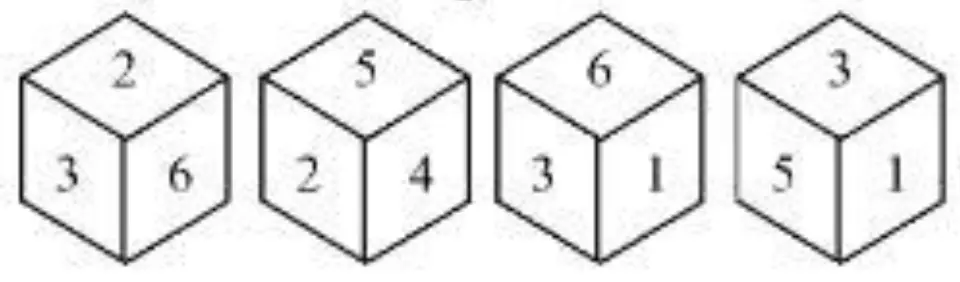
If four different positions of a dice are shown below, then what number is opposite 3?question figure
  • A6
  • B4
  • C3
  • D2
Pick an option to attempt
Read off every face that shares a view with 3. The first die shows 3 with 2 and 6, the third shows it with 6 and 1, and the fourth shows it with 5 and 1 - so 2,6,12, 6, 1 and 55 are all adjacent to 3. That leaves only one number unaccounted for, and a face can only be adjacent or opposite. Hence 4 is opposite 3, which is Option 2.
Q2:jipmat 2025LRDIDices & CubesMediumLR · MCQ
If a cube is painted yellow on all faces and cut into 27 small cubes of equal size, then which of the following are correct? A. Six cubes are painted on one face only. B. There is only one cube which is not painted on any face. C. There are six cubes which have two faces painted. D. There are eight cubes which have three faces painted.
  • AA and B only
  • BA, B and C only
  • CA, B and D only
  • DC and D only
Pick an option to attempt
The Setup: We are dealing with a standard n×n×nn \times n \times n painted cube problem. The total number of cubes is 27, which means n3=27n^3 = 27, so n=3n = 3. We can dox the exact counts using the standard formulas. Step 1: Stat-check the formulas * 3 faces painted (Corners): Always exactly 8. (Statement D is True) * 2 faces painted (Edges): 12×(n2)=12×(32)=1212 \times (n - 2) = 12 \times (3 - 2) = 12. (Statement C says six, so C is False) * 1 face painted (Face centers): 6×(n2)2=6×(1)2=66 \times (n - 2)^2 = 6 \times (1)^2 = 6. (Statement A is True) * 0 faces painted (Inner core): (n2)3=(1)3=1(n - 2)^3 = (1)^3 = 1. (Statement B is True) Step 2: Secure the final bag Statements A, B, and D are perfectly accurate. Final Answer: A, B and D only

Browse other topics